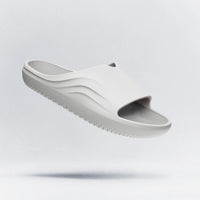
Oofos vs. STAND+: Which Recovery Shoe Is Right for You?
Oofos vs. STAND+: Which Recovery Shoe Is Right for You?
Both brands make recovery footwear. They were built for different people doing different things. The right answer depends less on which brand is "better" and more on what your feet are recovering from.
Oofos and STAND+ are two of the more talked-about names in recovery footwear. They share a category but not a philosophy. Oofos was built for athletes recovering from training. STAND+ was built for workers recovering from standing. The distinction sounds minor. It isn't, once you understand the underlying biomechanics each brand optimized for.
Here's a direct comparison.
Brand Background
Oofos launched in 2010 and established itself through the running and triathlon communities. The brand's signature product is OOfoam, a proprietary closed-cell foam that absorbs impact while returning energy to the wearer. Oofos slides and sandals became a fixture in locker rooms and at race finishes, worn by athletes transitioning out of performance footwear into something their feet could decompress in. The brand's tagline, "for the other 22 hours of the day," reflects its positioning: it's what you wear when you're not working out.
STAND+ launched during the COVID-19 pandemic, specifically to address the footwear needs of nurses and healthcare workers spending 10–12 hours on their feet in hospital environments. The brand's engineering approach centers on energy dispersal rather than energy return, a different mechanical approach that aims to reduce the vertical compressive load on joints over extended standing rather than assist propulsion after exercise. STAND+ has since expanded into pro sports and food service, but the foundational user is still someone whose feet need to survive a full shift, not just a post-gym hour.
Technology
Oofos OOfoam is a proprietary closed-cell foam that absorbs 37% more impact than traditional EVA foam, according to the brand's own testing. Like all energy-return foam, it compresses under load and rebounds, partially returning the stored energy back to the wearer. This reduces the muscular effort of forward motion and is well-documented to assist post-run recovery in athletes.1 The drawback in high-volume standing use: the rebound pushes force back up through the heel and into the joint stack repeatedly over a long shift.
STAND+ AntiGrav technology uses a midsole and outsole system engineered to absorb impact and dissipate it laterally rather than returning it vertically. The goal is to reduce the compressive joint load that accumulates during prolonged standing. Every pair includes an OrthoLite X-40 recovery insole, a two-layer open-cell PU foam system with an anatomically shaped heel cup and less than 5% compression set over time, meaning it maintains its cushioning properties through extended daily use.2
Certifications and Medical Credentials
This is where the brands diverge most clearly.
Oofos is widely recommended by podiatrists in clinical settings and has a strong reputation in the running medicine community. However, the brand does not hold the APMA Seal of Acceptance.
STAND+ carries the APMA Seal of Acceptance from the American Podiatric Medical Association, which evaluates footwear submitted for review by a committee of podiatrists and grants the seal to products that allow normal foot function and promote quality foot health.3 STAND+ is also podiatrist-approved, ASTM-certified for slip resistance, and HSA/FSA eligible through Truemed for qualified customers.
| Credential | Oofos | STAND+ |
|---|---|---|
| APMA Seal of Acceptance | — | ✓ |
| Podiatrist-approved | Widely recommended | ✓ Formally approved |
| ASTM slip-resistance certification | — | ✓ |
| HSA/FSA eligible (direct checkout) | — | ✓ via Truemed |
| Antimicrobial, fluid-resistant exterior | — | ✓ |
| Machine-washable | Some styles | ✓ |
| Heat-moldable fit system | — | ✓ |
Who Each Brand Is Actually For
Choose Oofos if:
You're primarily an athlete or active person using recovery footwear for 1–3 hours after training sessions. You want a slide or sandal you can slip into after a run, gym session, or bike ride. You value a brand with wide retail availability at running specialty stores and sporting goods chains. You're not working in an environment that requires slip-resistant certification, fluid resistance, or antimicrobial materials.
Choose STAND+ if:
You stand for 6–12 hours professionally, whether in healthcare, food service, or any other standing-intensive environment. You need certified slip resistance for hospital floors, commercial kitchen surfaces, or wet work environments. You want to use HSA or FSA funds to purchase footwear. You need a shoe with APMA certification and medical-grade credentials. You're an athlete or training staff member using the shoe for extended active recovery between sessions rather than brief post-workout decompression.
Retail Footprint and Price
Oofos is available at major running specialty retailers, sporting goods chains, and direct. The slides start around $60; closed-toe styles run higher.
STAND+ sells primarily direct-to-consumer at standshoes.com with B2B sales to sports organizations and healthcare institutions. HSA/FSA eligibility through Truemed means qualified customers can use pre-tax health savings dollars, reducing out-of-pocket cost by 20–40% depending on tax bracket.
The Honest Bottom Line
Oofos is a well-made recovery shoe that has earned its reputation in the athletic community. If you're using recovery footwear the way Oofos designed it to be used, it's a reasonable choice.
STAND+ addresses a different problem. The tens of thousands of nurses, healthcare workers, and standing professionals who have used it report something Oofos slides can't deliver: a shoe that holds up through a full clinical shift, doesn't slip on wet floors, can be wiped down with a Lysol wipe between patients, and reduces foot and knee pain in a way the running-focused recovery shoe market hasn't historically addressed.
The question isn't which brand is better. It's which problem you're trying to solve.
References
- Hoogkamer W, et al. "A Comparison of the Energetic Cost of Running in Marathon Racing Shoes." Sports Medicine. 2018. doi:10.1007/s40279-017-0811-2
- OrthoLite. "X40 Technology Overview." ortholite.com/insole/x40/
- American Podiatric Medical Association. "APMA Seal Program for Footwear and Products." apma.org